Defining newsroom strategies through
end to end service design
The challenge
As part of a wider replatforming project, Reach needed to rebuild its live blog tool, the primary format for breaking news coverage. Understanding what it needed to do meant mapping the full journey from newsroom to reader.
What I did
As part of a Level 6 Service Design apprenticeship with real organisational application, I mapped the end to end breaking news lifecycle across two contrasting newsrooms:
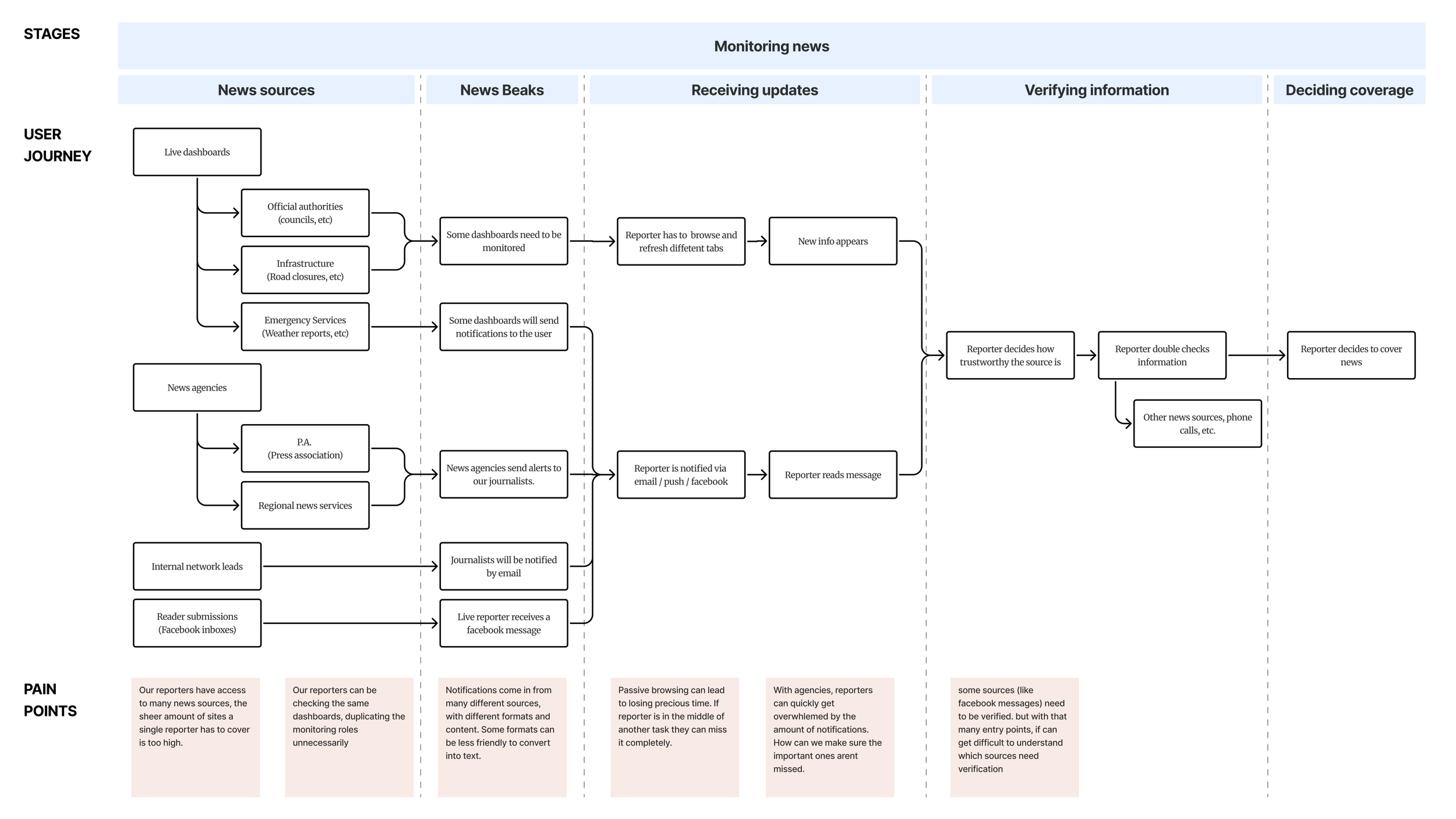
Shadowed journalists to understand how they monitor and verify incoming leads
Interviewed ten readers to explore how they discover and follow developing stories
Ran a root cause analysis and generated 30 potential solutions
Narrowed focus to a personalised notification system designed to build reader trust progressively rather than overwhelm them from the start
Outcome
Hi-fi prototype of a personalised notification system, ready for product handover
Editorial workflow recommendations to reduce friction in the newsroom
A reusable research framework for editorial teams to tackle similar problems independently



Full case study below
⬇
Breaking news tests how fast a newsroom can move, and quickly builds user trust if done right.
1. Introduction
This project started with an open brief: explore editorial workflows and identify where service design could make the most impact. Breaking news stood out quickly, as it operates under uniquely high standards, where time is the primary KPI and every second of friction has a measurable cost.
Why breaking news?
Last format to be addressed in a wider replatforming project.
Most complex format: reporters update stories continuously as events unfold, coordinating across editorial, production and distribution simultaneously.
Readers already trust regional brands as their primary source for local breaking news, a level of trust that is rare and easy to lose.
How I approached it
Discovery: internal research, user research and desk research.
Generating solutions: root cause analysis, ideation and concept evaluation.
Prototyping: building and testing solutions with real users.
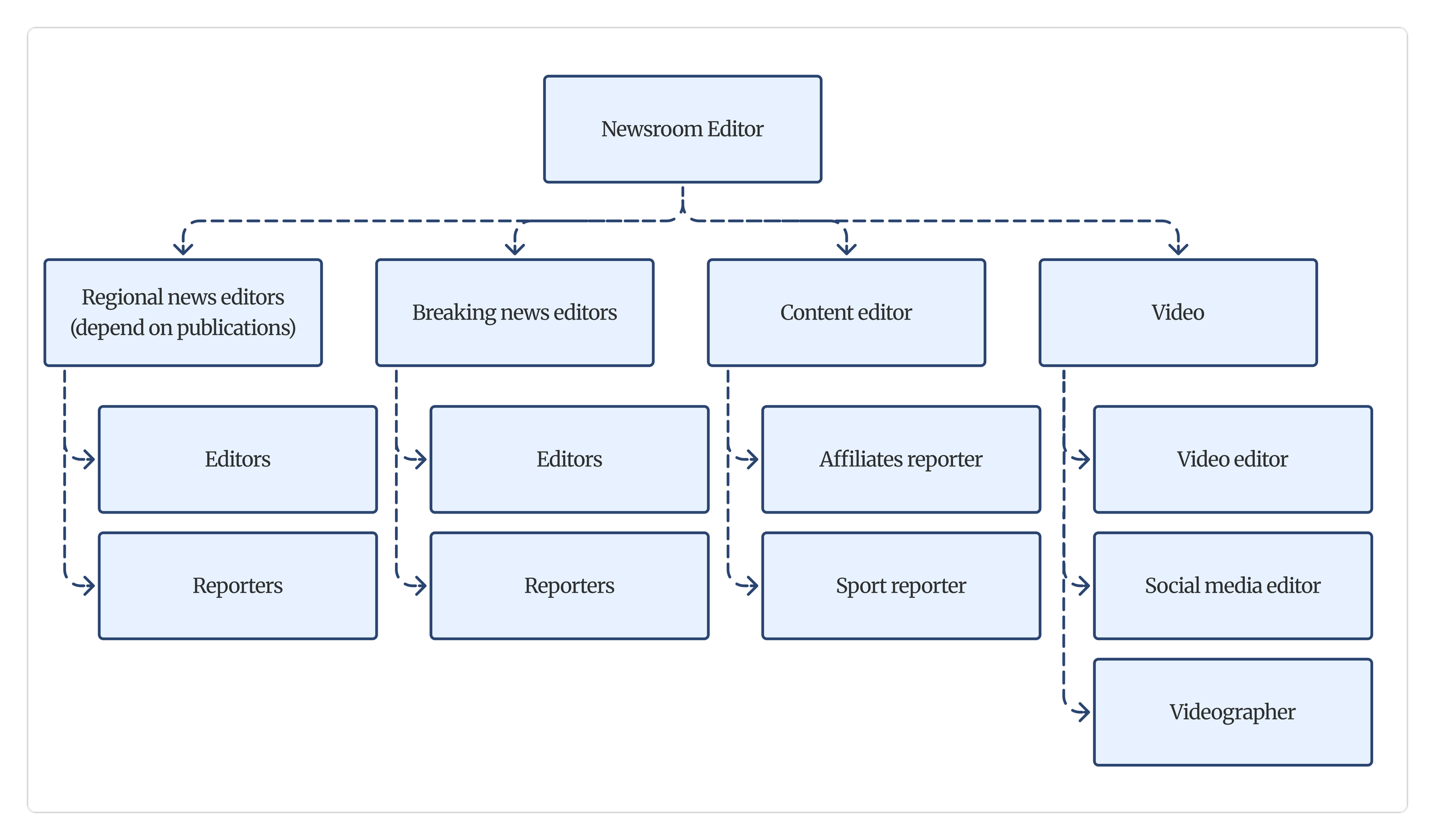
Typical regional newsroom structure
2. Discovery
Initial research
To understand how editorial teams operate, I ran shadowing sessions and semi-structured interviews across two contrasting newsrooms: the Liverpool Echo, a single major regional brand, and the South West newsroom, which covers multiple smaller titles. Comparing both gave a realistic picture of how workflows, handoffs and pain points shift depending on team structure.
Interviews covered every editorial role: Reporters, Editors, Social media and distribution teams.
Three research areas guided the sessions:
Types of content produced and what makes each different
Workflows from story origin to publication and distribution
Pain points around tools, handoffs and internal processes
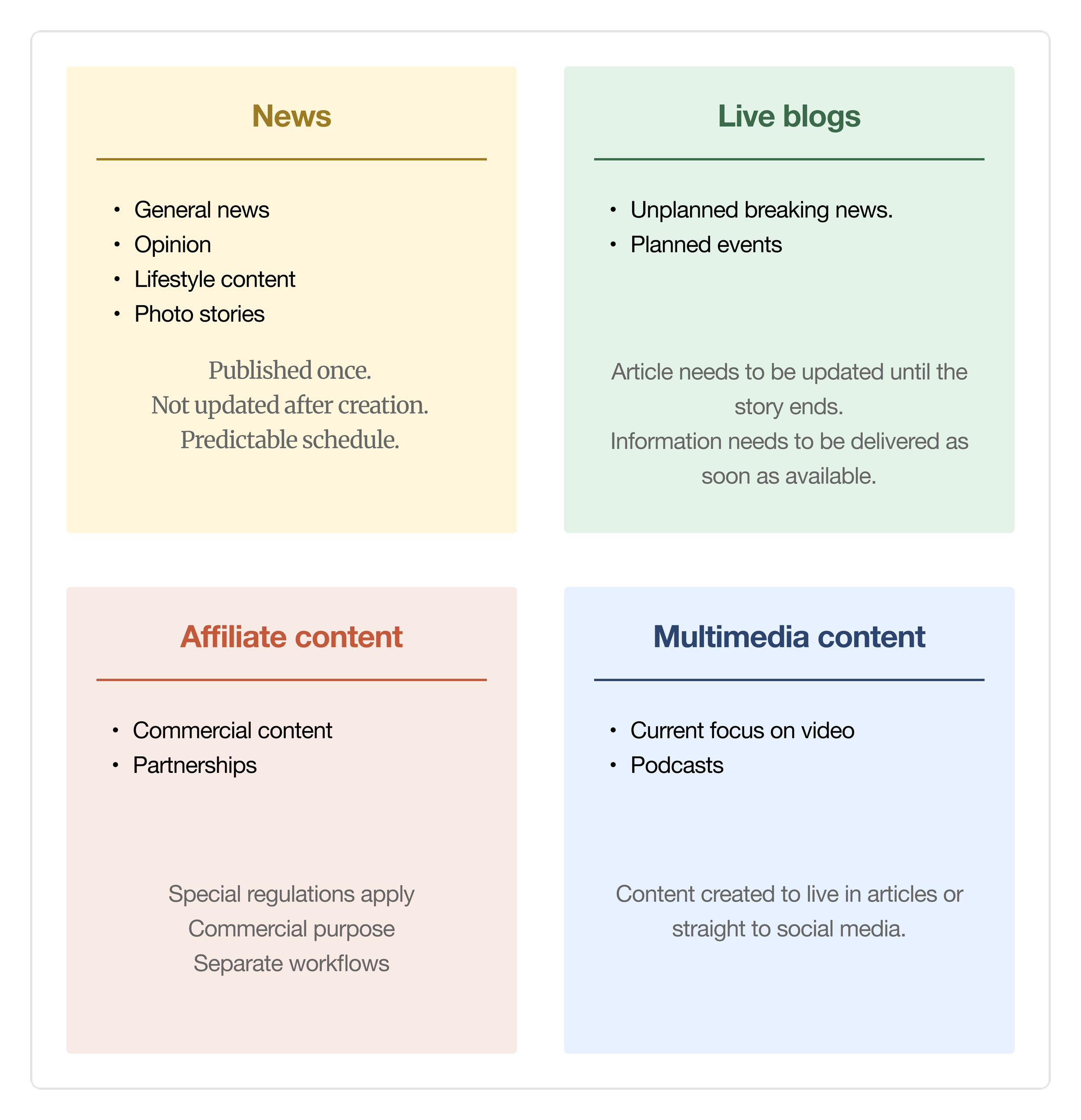
Types of content produced
Mapping breaking news workflows
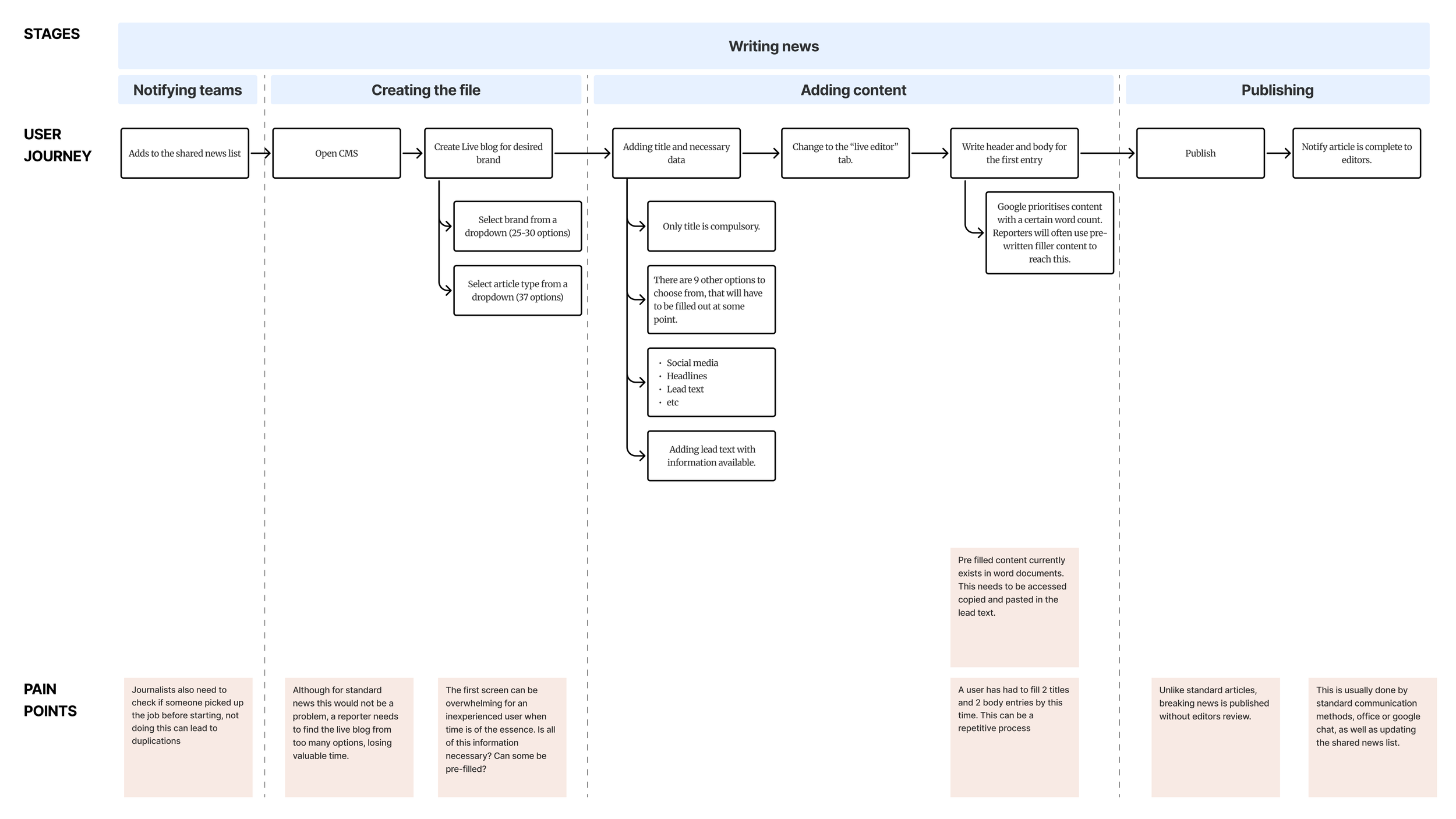
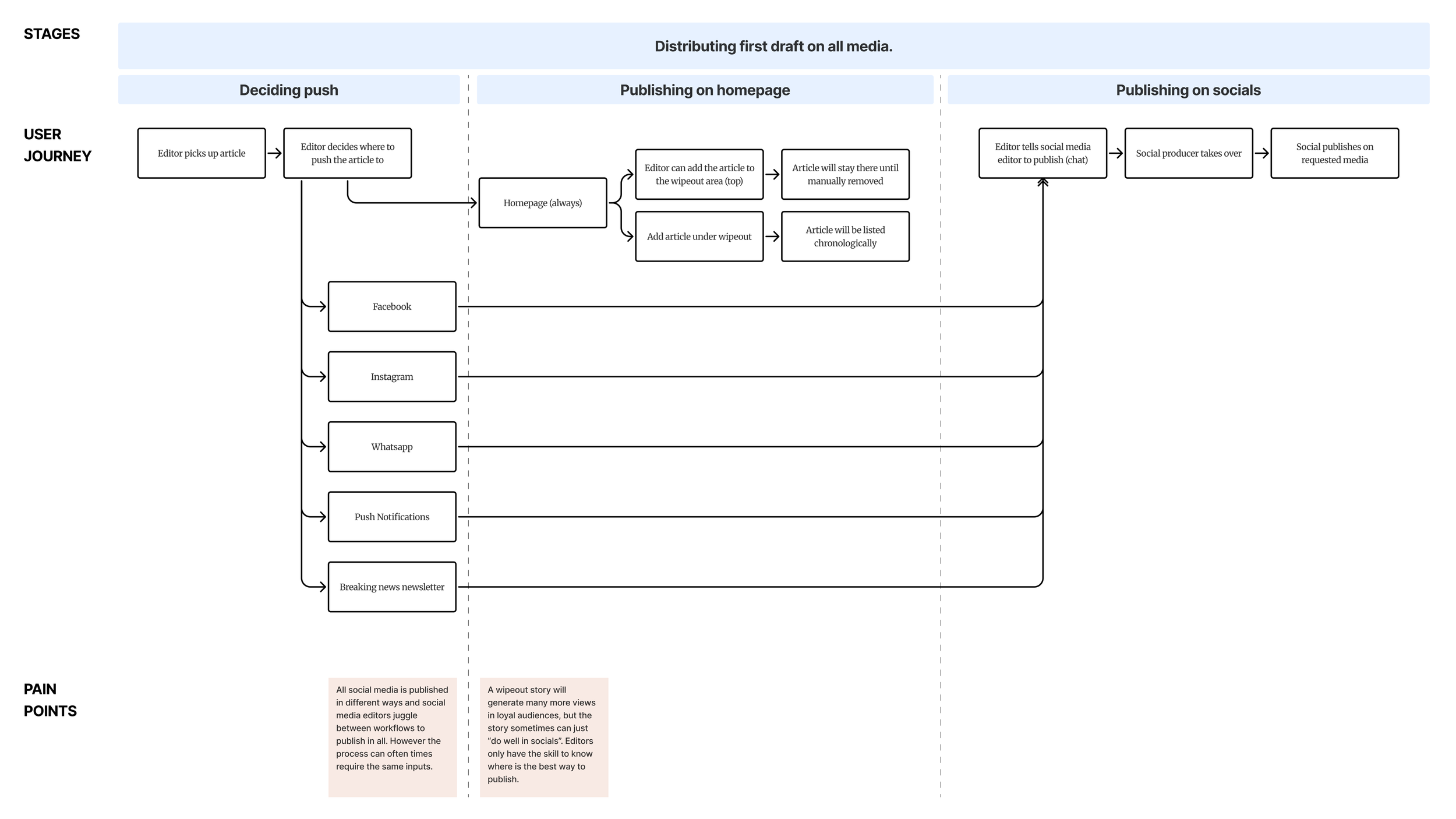
Breaking news is currently a subcategory of live blogs, a tool used for planned and unplanned events. When a story breaks, it requires instant coordination across reporters, editors and distribution teams. To understand where friction occurs, I mapped the end to end lifecycle of a breaking news story across three phases:
Monitoring: how journalists discover and verify incoming leads
Writing: how reporters create and publish live updates under time pressure
Distributing: how editors broadcast the story across channels to reach readers
Internal personas
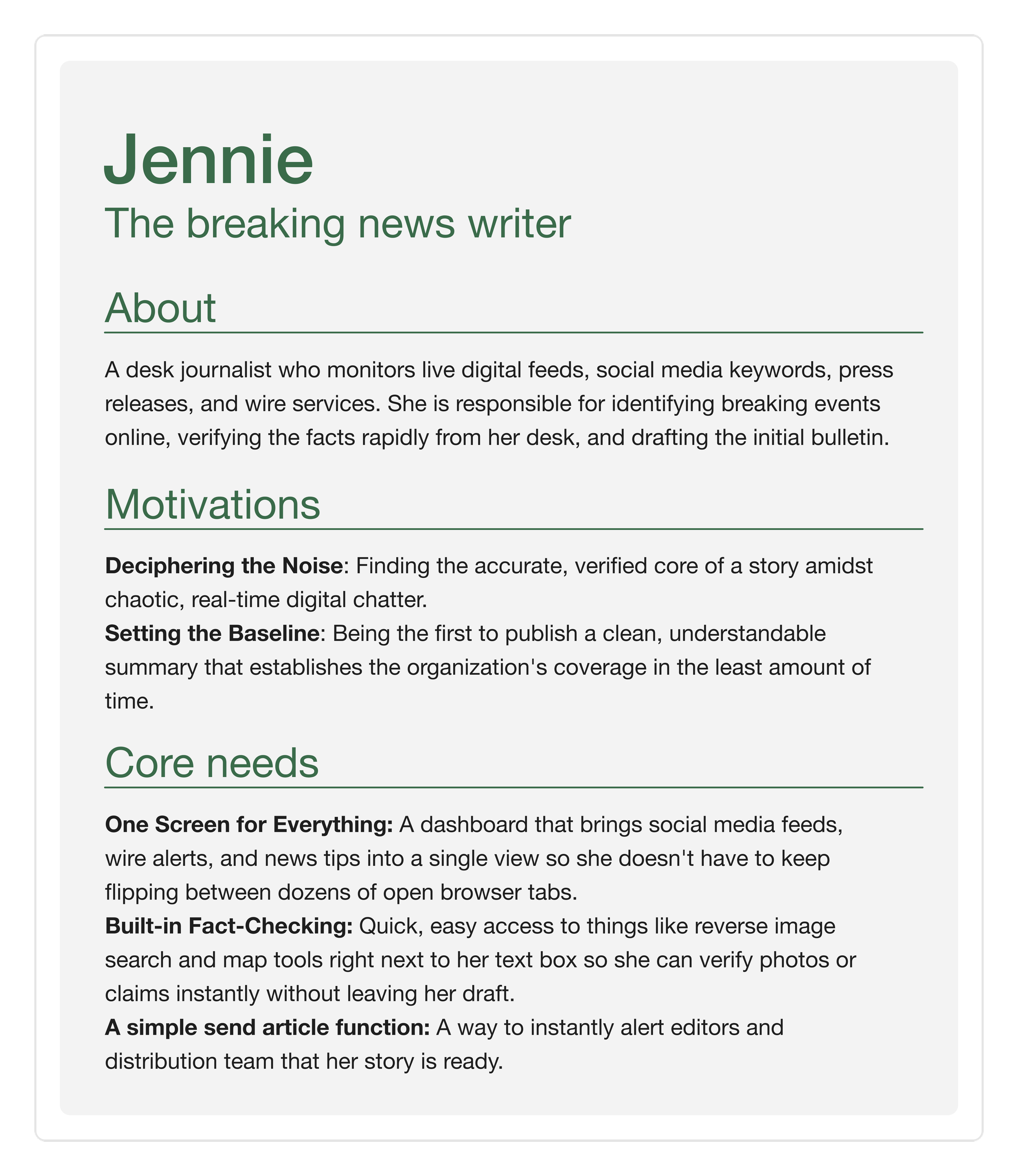
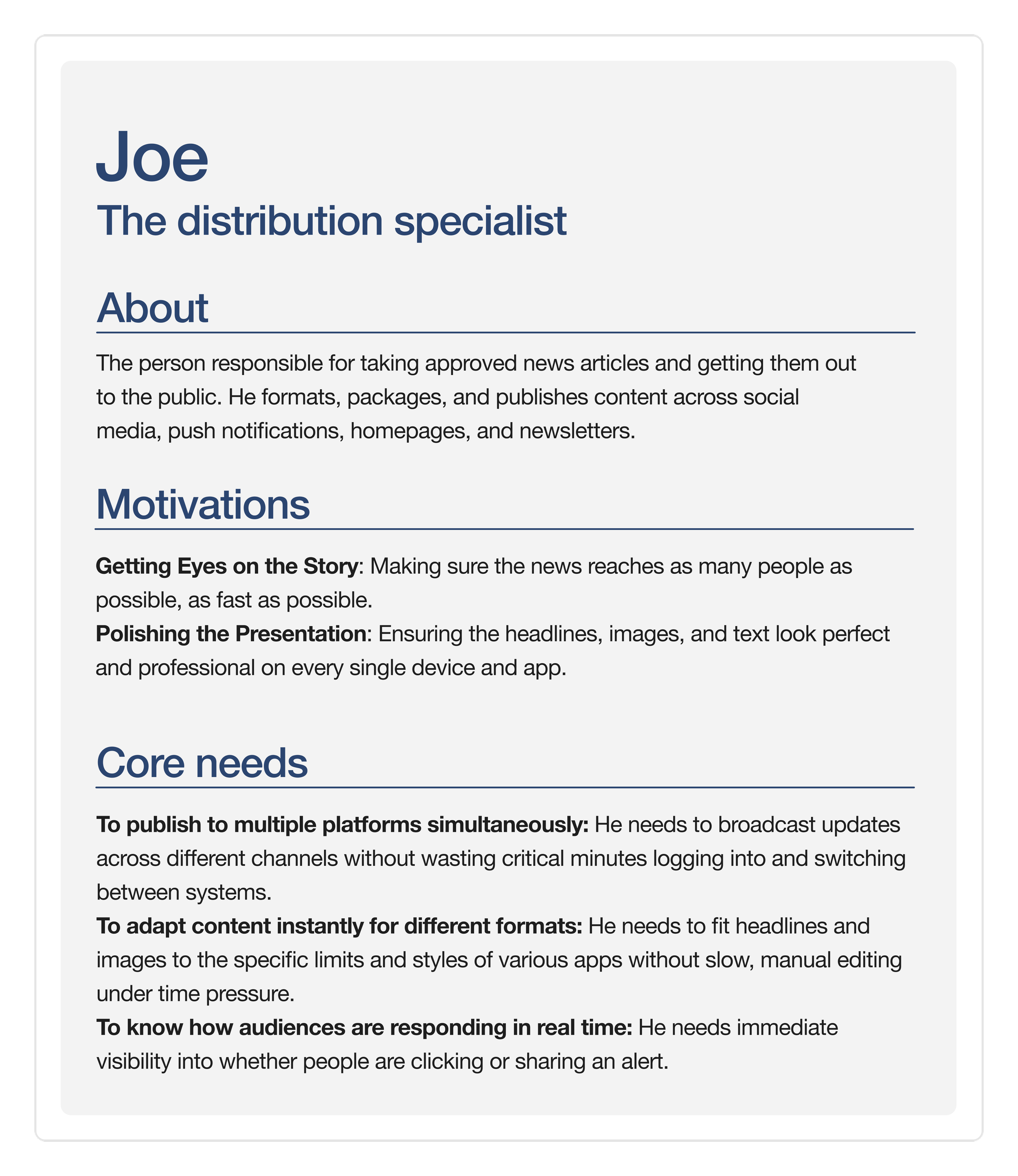
To translate the workflow research into actionable service design needs, I developed two personas representing the core editorial roles involved in breaking news coverage.
Jennie, The breaking news writer: Jennie represents desk journalists responsible for discovering leads, verifying facts, and writing live updates under intense time pressure.
Joe, The distribution specialist: Joe represents engagement editors responsible for formatting and publishing approved editorial content across external channels.
User research plan
To test how readers behave around breaking news, I ran ten semi-structured interviews with local news readers, exploring five areas:
How readers first discover breaking news
Their attitudes towards notifications, newsletters and WhatsApp
Trust levels across local and national publications
Whether they prefer speed or verified coverage
How they decide if a story is worth following

10 participants
Recruited via UserTesting.com

2 cohorts
Loyal brand readers
Digital natives

Semi structured
interviews
30 min
Findings
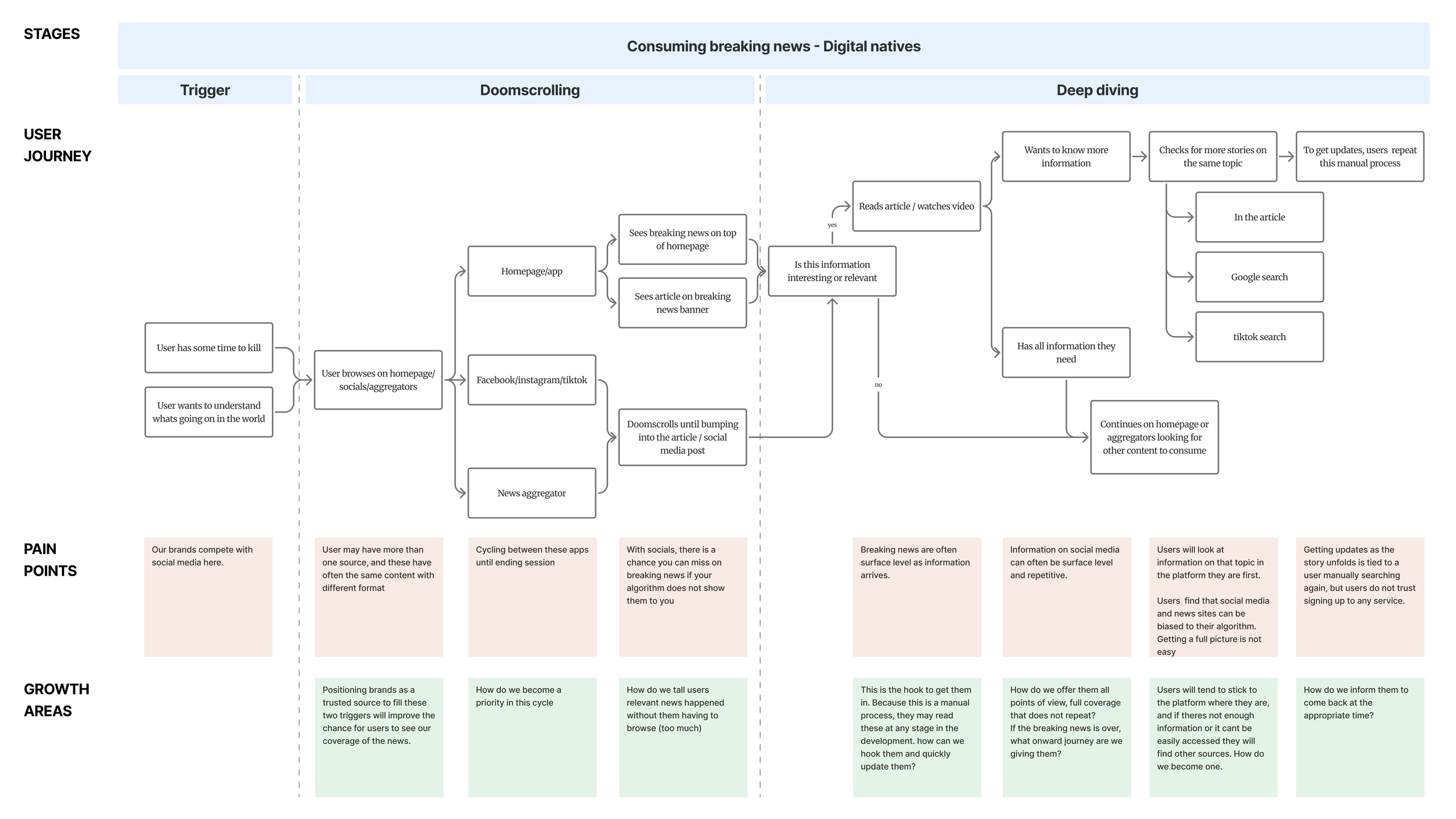
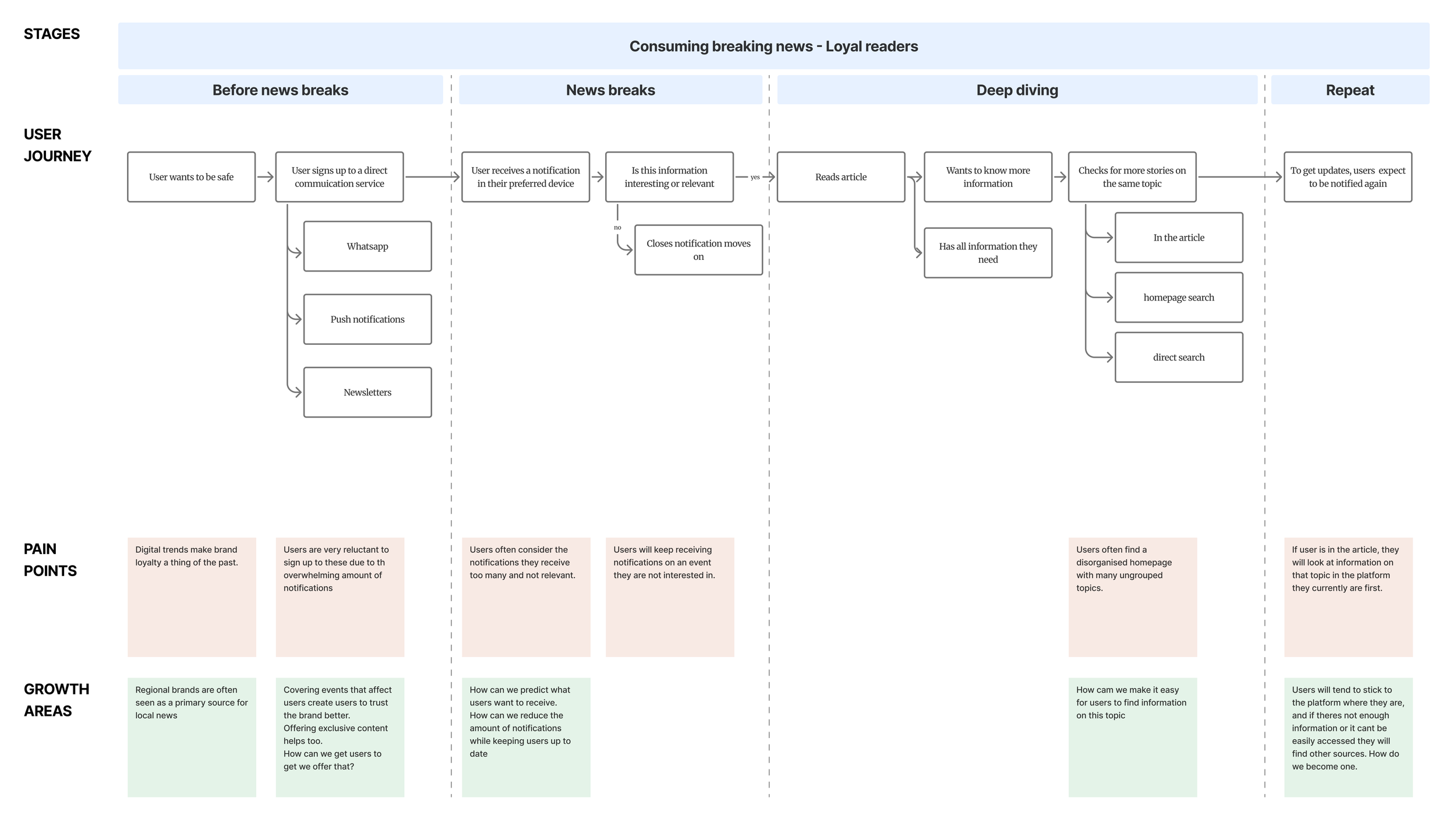
Two distinct discovery workflows emerged from the research, reflecting fundamentally different relationships with news:
Casual readers encounter breaking news passively through social feeds, only actively seeking more when a story directly affects them
Loyal readers intentionally opt into direct publisher communication, wanting to stay informed about their community in real time
Both groups shared the same frustration: notification fatigue. Too many irrelevant alerts were either muting engagement or driving readers away entirely.
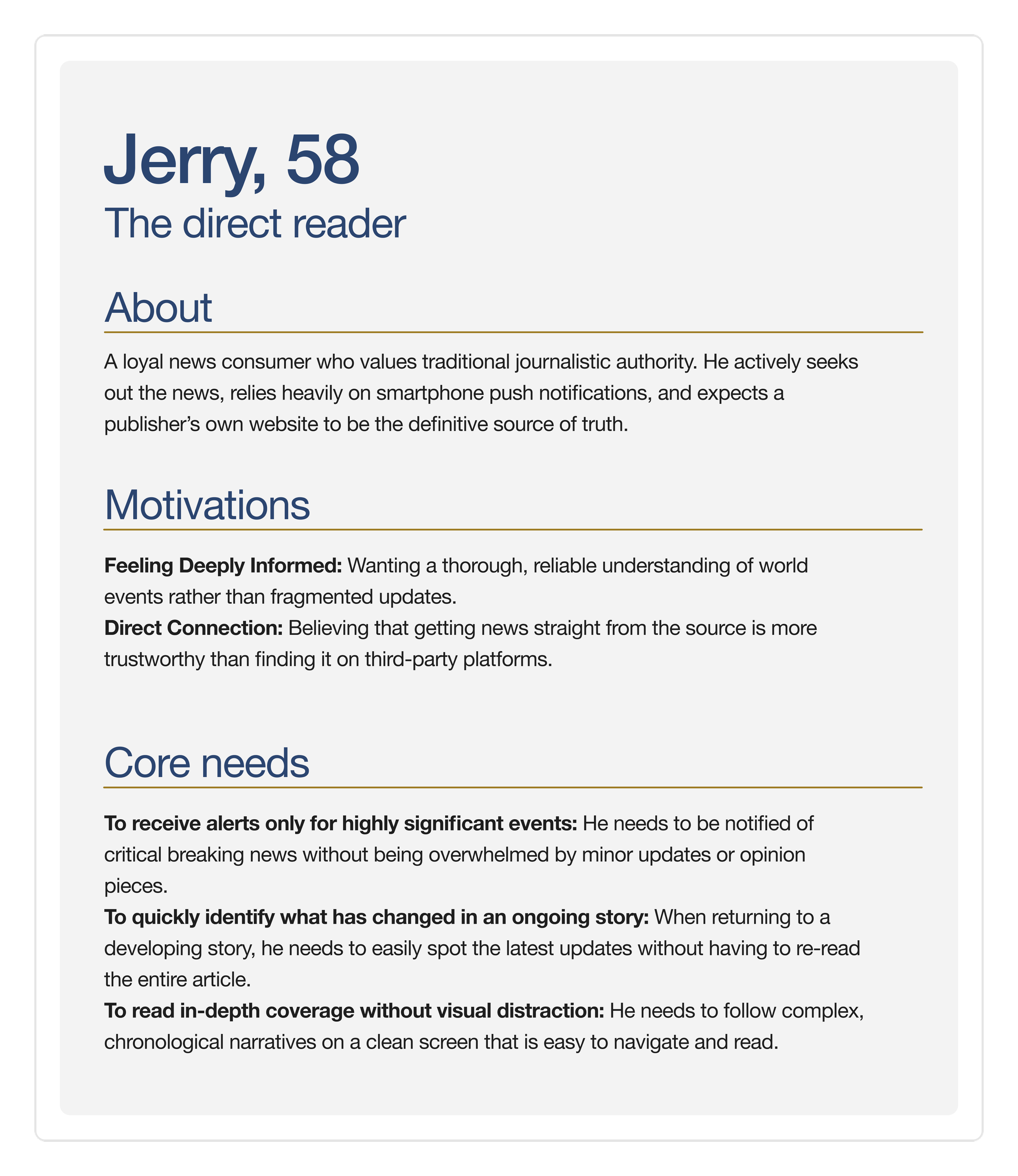
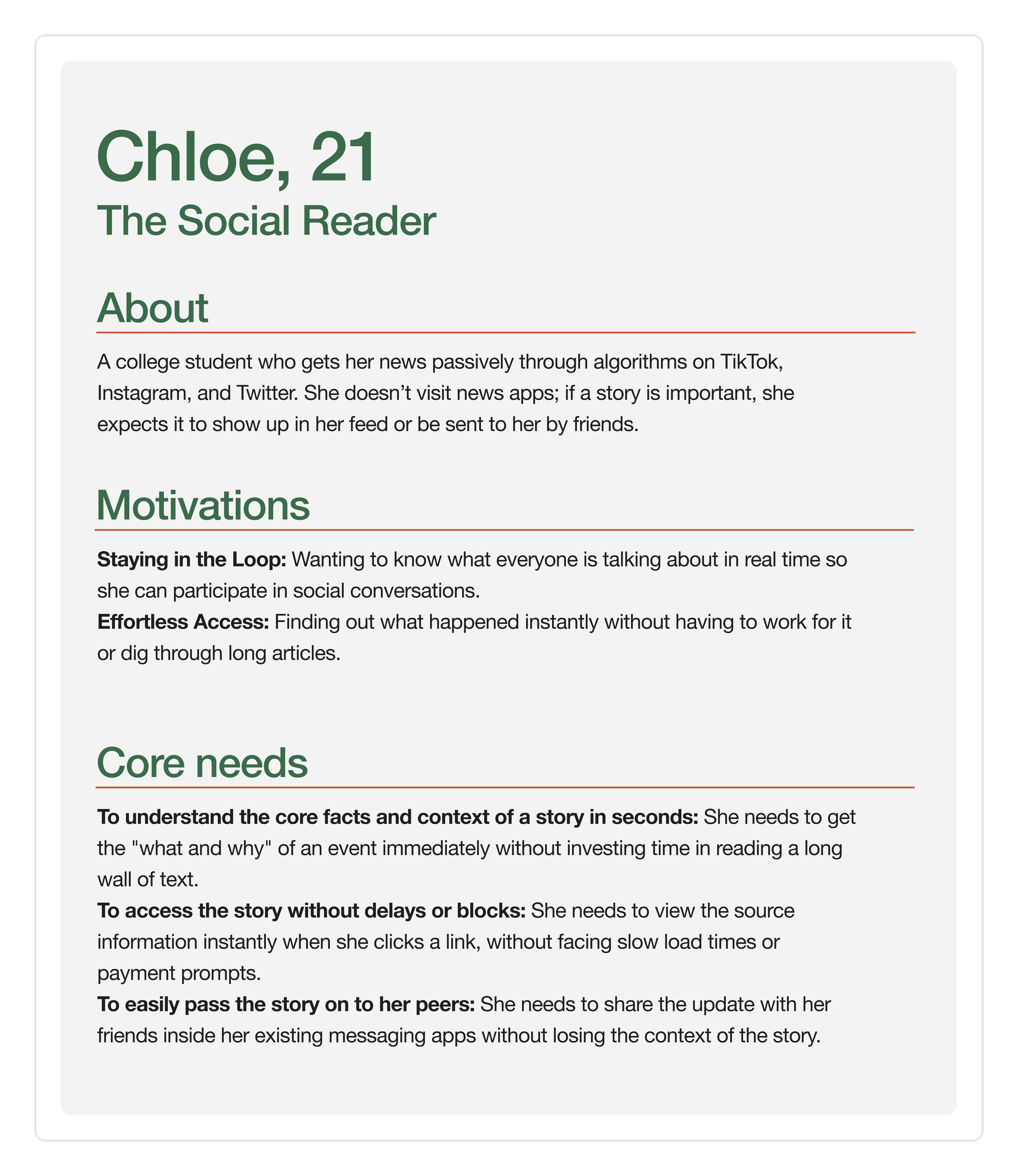
User personas
To translate how readers discover and experience breaking news, I developed two personas representing the distinct audience behaviours that emerged from the research.
Jerry, the direct reader: a loyal local news consumer who actively seeks out breaking news and expects the publisher to be his definitive source of truth
Chloe, the social reader: a digital native who encounters news passively through social feeds and only goes deeper when a story directly captures her attention
3. Exploring solutions
From discovery to focus
The discovery phase surfaced pain points across all four stages of the breaking news lifecycle — monitoring, writing, distributing and reading. Each area had clear opportunities, and recommendations were developed for all of them.
The reading experience emerged as the main priority. Unlike improvements to monitoring or publishing workflows, solutions here sat entirely within our control to design, prototype and test — and they addressed the root cause that ran through every other phase: readers not trusting our brands enough to opt in to direct communication.
“How might we provide instant breaking news access whenever readers want it, turning casual visits into trusted, long term brand relationships?”
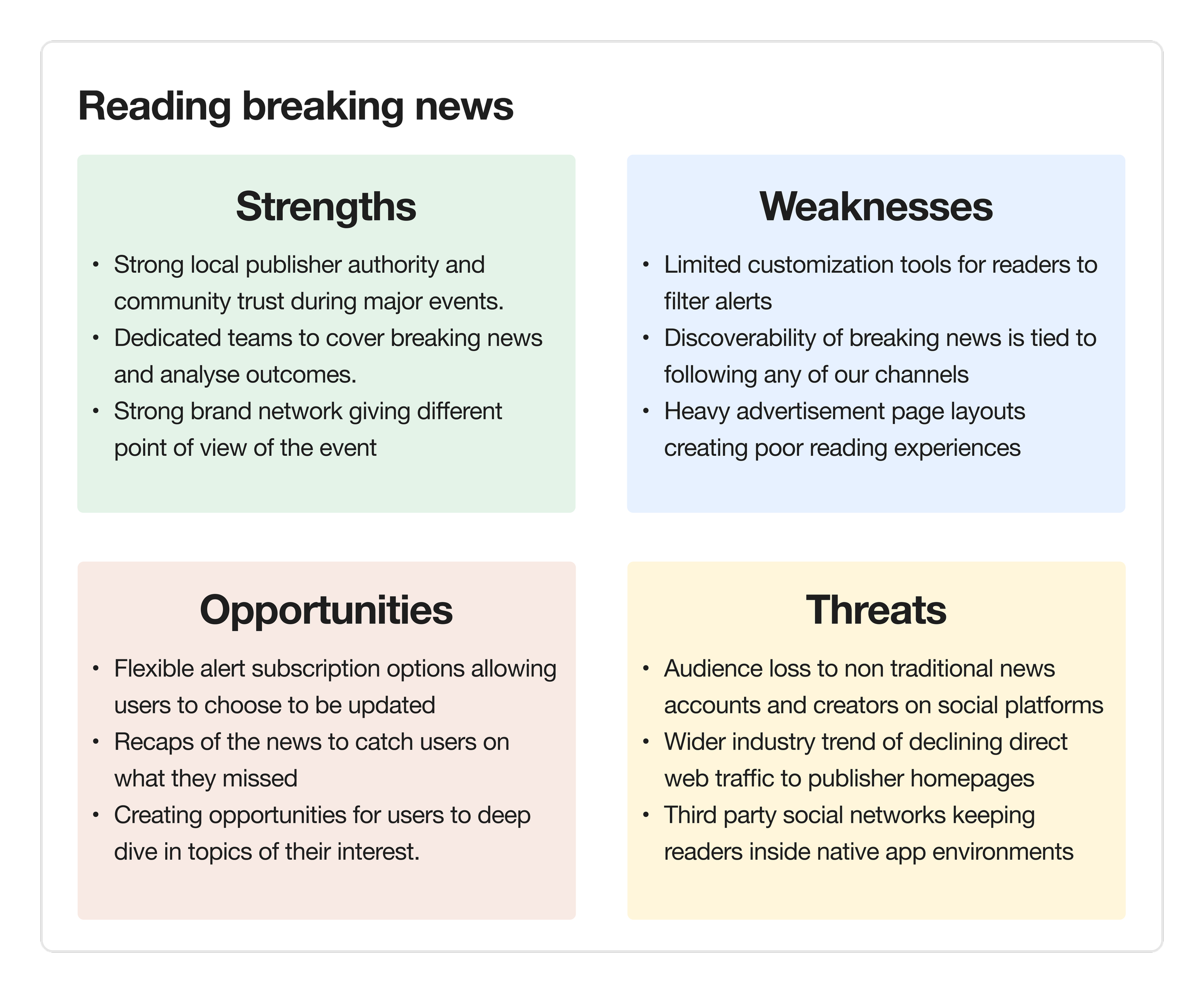
Reading breaking news - SWOT analysis
Exploring solutions
To explore the solution space without narrowing too early, I generated 30 potential solutions across six strategic areas — from filtering irrelevant notifications to building trust in our brands before readers even open the app.
Each solution was then mapped onto an impact and effort matrix, weighing four effort factors (third party dependency, development speed, editorial maintenance, implementation cost) against three reward factors (reader reaction, reach and long term brand trust).
A clear pattern emerged. Strategies centred on notification management clustered in the high impact, low to moderate effort quadrant — directly targeting the root cause uncovered in the research: readers losing trust in our brands because of notification overload. That became the focus.
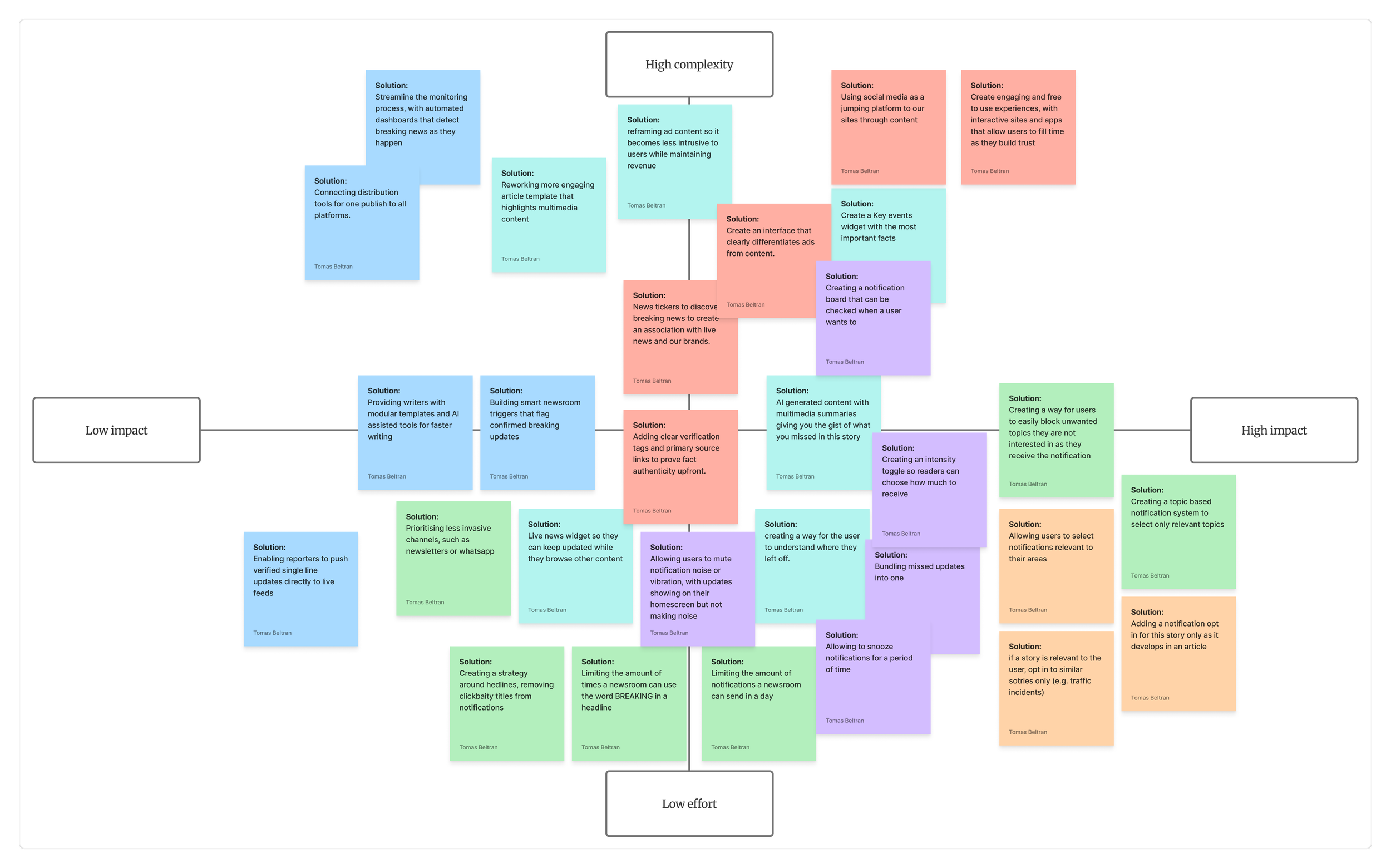
Impact - Effort Matrix
4. Conclusions
This project is a full service design process from start to finish, and it shows what that actually looks like in practice.
I scoped the problem myself, mapped stakeholders, and decided where to focus before anyone told me to
I ran internal and external research simultaneously, uncovering pain points across the full breaking news lifecycle from newsroom to reader
On top of presenting a list of recommendations, I focused on a solution that was tangible, testable and ready to hand over to product
The notification system prototype reflects real user needs, validated through research, not assumptions
What I learned
You cannot design a reader experience without first understanding what happens before the reader ever arrives. Understanding internal workflows surfaced many problems.
Shadowing journalists in real conditions revealed pain points that no interview would have surfaced.
Focusing on what is within your control is a design decision in itself. There were bigger systemic problems we could not touch yet. Choosing to design around them rather than through them was the right call.